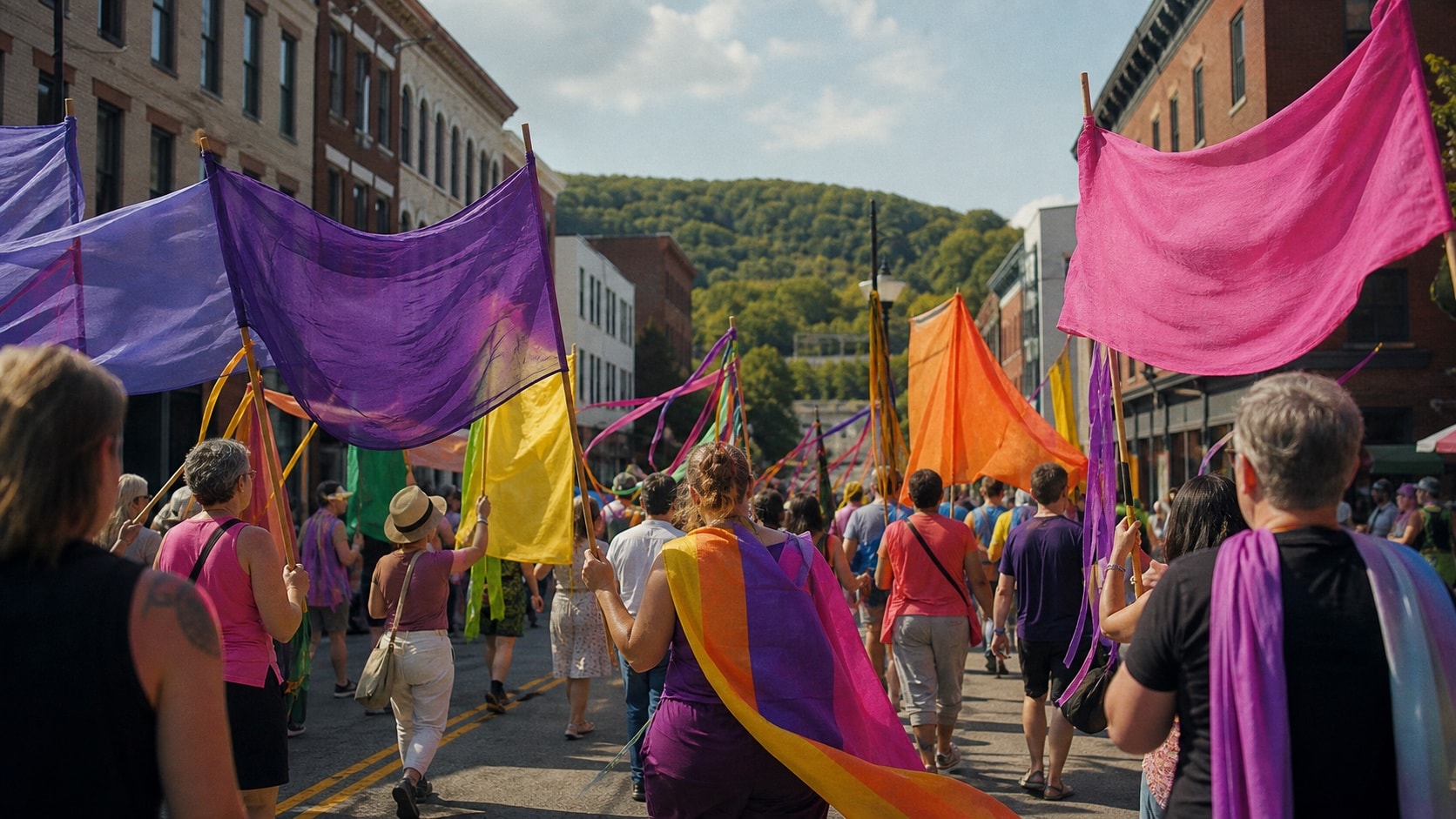
The Pride March
The march was Northampton Pride's most visible public act. It transformed a collection of individuals and small groups into a procession moving through the city together. Banners, handmade signs, music, costumes, quiet walkers, organized contingents, and spectators all contributed to its changing character. What united those forms was movement through shared civic space.
Historical accounts of the first 1982 march place its beginning near the Bridge Street School, followed by a route along Main Street and a rally in Pulaski Park. Later logistics varied, and this reference does not present an old route as current instruction. The historically durable point is the choice of downtown itself: the march asked the city to witness LGBTQ people as part of its public life.
Why a route matters
Public marches use geography as language. An assembly point allows participants to gather confidence and organize themselves. A central street brings the message into ordinary civic and commercial space. A rally destination shifts the crowd from movement to speech, music, and conversation. Northampton's route connected all three functions.
Main Street was especially significant because it was familiar. Marchers were not traveling through an abstract ceremonial corridor; they were using a street associated with work, errands, shopping, dining, and local government. Visibility entered the everyday landscape. The annual return made that claim more durable.
Many ways to take part
A Pride procession is not a single visual block. Some people march with an organized group, while others walk with friends or join individually. Some carry signs; others do not. Some perform; others watch from the edge before deciding whether to step in. Period coverage of Northampton describes a broad regional gathering in which both coordinated contingents and informal participation could be seen.
Behind that openness was careful labor. Procession coordinators helped groups assemble and move. Volunteers communicated the route, watched crossings, distributed materials, responded to questions, and connected the march to the rally site. Design and production teams prepared visual material before event day. Cleanup workers remained after much of the crowd had left.
The volunteer history page explains those roles in more detail. This is historical information only; no current volunteer placement or application is offered.
Expression without a single message
The march could hold multiple meanings at once. For some participants it was a political statement about equality, safety, family, or civic rights. For others it was a first chance to be publicly present among peers. Still others came to support a friend, celebrate, perform, document, or remember. Annual themes created a shared frame, but they did not eliminate this variety.
That plurality is part of the historical record. Pride marches reveal which issues a community is debating, which identities are explicitly named, and how public expression changes over time. Photographs are especially valuable because they preserve details that formal summaries omit: spacing between groups, interactions with spectators, homemade design, and the physical scale of the street.
Reading the march today
This page does not supply a present-day start time, route map, access instruction, or safety advisory. The organization behind the historic event is no longer operating. Readers seeking evidence can use the local march exhibition and the public photographic archive. Together they show how the procession changed while its central action—walking visibly through Northampton—remained recognizable.
Seen historically, the march was both temporary and cumulative. Streets returned to ordinary traffic, banners were packed away, and volunteers went home. Yet each procession added another layer to the city's public memory. The event asserted that visibility was not a one-time exception but a tradition.
Its documentary value rests in that repetition. Comparing images and programs across years can reveal changing language, scale, design, and participation while keeping the physical street as a point of continuity.